Don't miss our Festive Offers- up to 40% OFF! Free Testers on All Prepaid Orders.
Don't miss our Festive Offers- up to 40% OFF! Free Testers on All Prepaid Orders.

From the GI-Recognised Heritage Region of Kannauj
The Deg-Bhapka Method A craft practiced without interruption for one thousand years.
Every Mandakani attar begins here —in a copper vessel, over a wood fire, in Kannauj. No shortcuts. No synthetic substitution. No outsourcing.
The Four Stages — At a Glance
Harvest
Fresh botanicals harvested at pre-dawn, before sunrise.
The Deg
Petals and water sealed in copper deg. Wood fire lit below.
The Chonga
Steam travels through bamboo pipe to the receiver.
The Bhapka
team condenses into sandalwood oil. Attar is born.
Stage by Stage —Every Step of the Deg-Bhapka Process
This is not a summary. This is exactly what happens in our Kannauj workshop, in the order it happens, every time an attar is made.
Stage 1 — Pre-Dawn Harvest
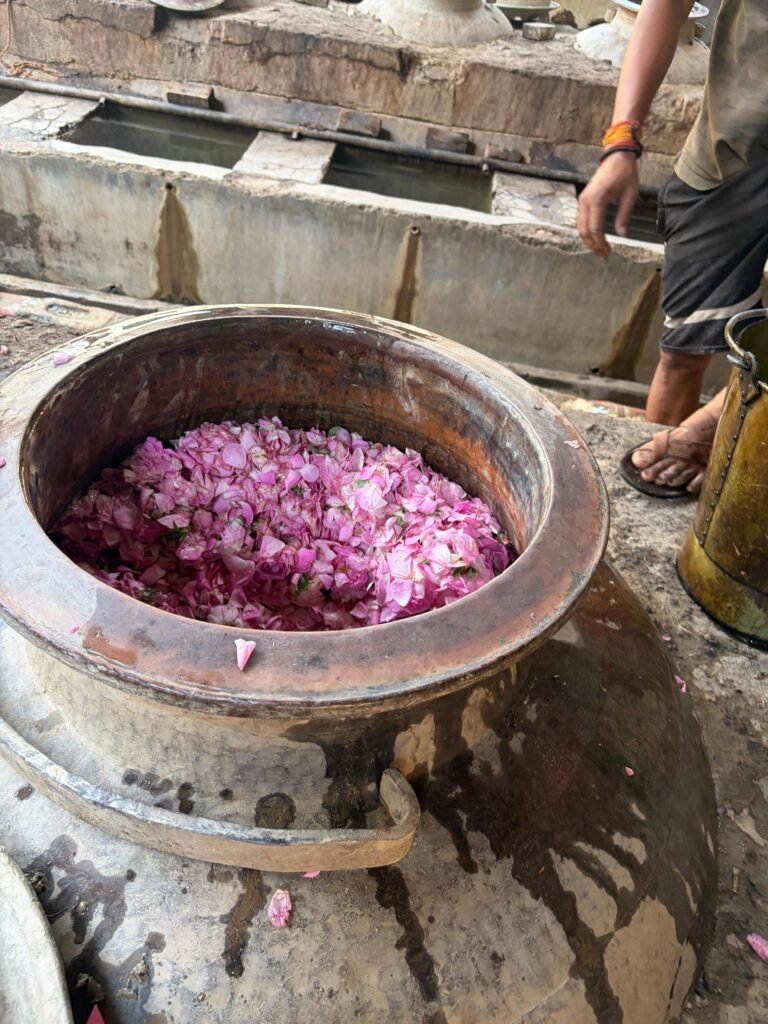
The process begins before sunrise. Rose petals must be harvested while the dew is still on the flower — after the sun rises, the volatile aromatic compounds that carry the scent begin to evaporate rapidly.
In our Kannauj distillery, the harvest window is between 4 AM and 7 AM. Experienced collectors work by hand — no mechanical harvesting, as the petals bruise easily and oxidation begins within minutes of damage.
For one kilogram of pure Rose Attar, between 3,000 and 5,000 kilograms of fresh rose petals are required. This is why true attar is priced the way it is — and why it cannot honestly be replicated in a factory.
Stage 2 — Loading the Deg
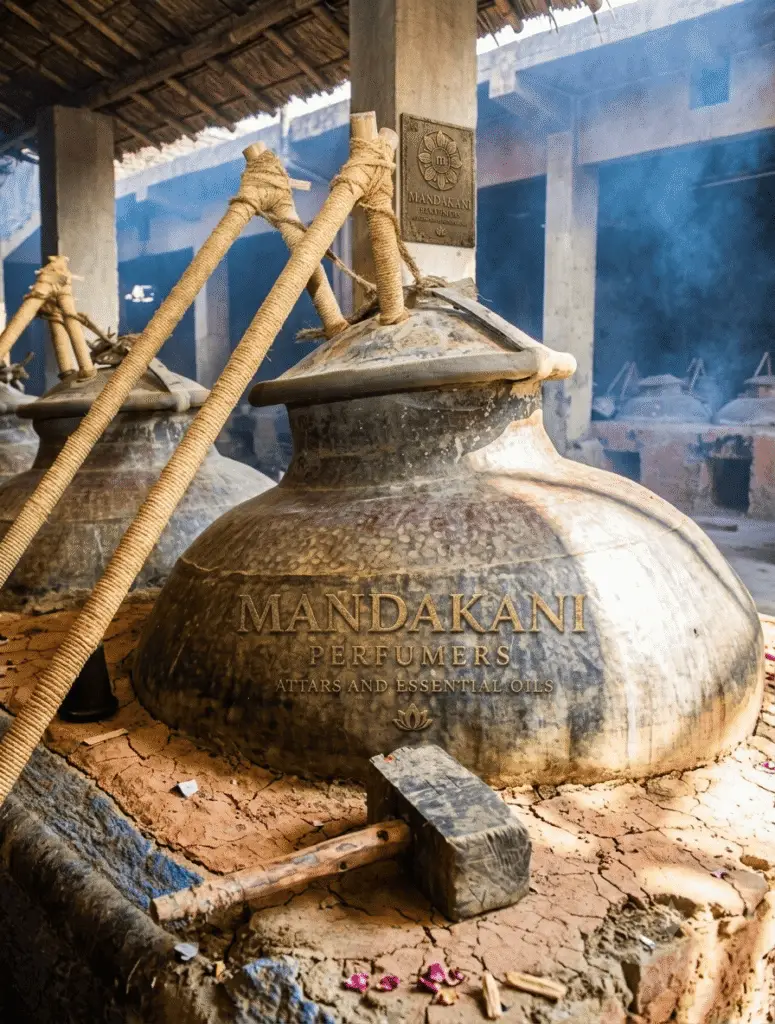
The Deg is a large copper vessel — in our workshop, our degs hold between 40 and 80 kilograms of botanical material. Copper is used deliberately: it distributes heat evenly and does not react with delicate aromatic compounds the way iron or steel would.
Fresh petals are layered into the deg with a precise quantity of water. The ratio of petals to water is a matter of family knowledge — not written down, not standardised, learned through years of observation.
The lid (Sarpos) is placed on top and sealed with a mixture of clay and cotton — an airtight seal that ensures no steam escapes except through the chonga. Our master distillers have been sealing degs this way for four generations.
Stage 3 — Lighting the Bhatti
The Bhatti is the traditional furnace — a brick chamber beneath the deg in which wood or dried cow-dung cakes are burned. The heat is low and controlled —there are no thermostats, no gauges. The master distiller monitors heat by placing a hand near the vessel and listening to the sounds from inside.
This is not a metaphor for authenticity. It is a practical skill that takes years to develop — knowing when the fire is too hot, when it needs fuel, when to let it die down. A deg that overheats destroys the very aromatic compounds it is meant to extract.
The fire burns for 8 to 12 hours per distillation cycle.
Stage 4 — The Chonga (Bamboo Pipe)
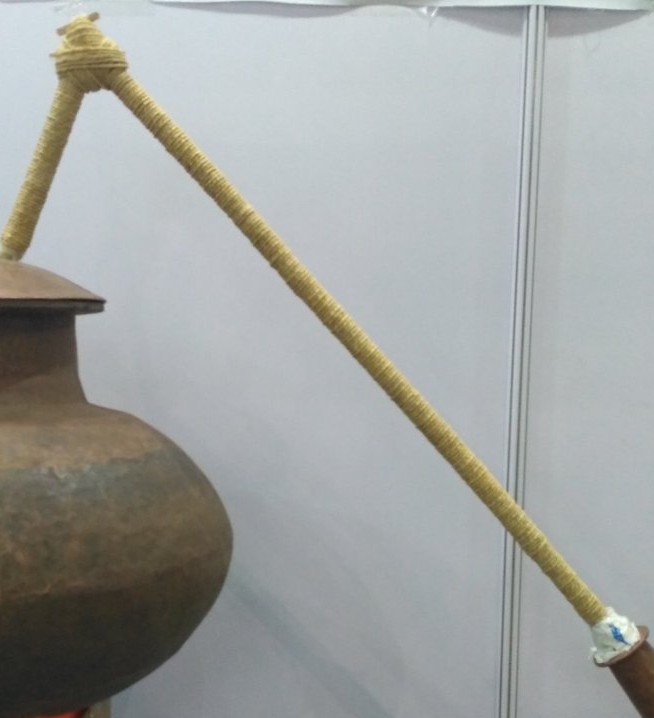
As the deg heats, aromatic steam rises and exits through a bamboo pipe called the Chonga — wrapped tightly with rope made from local grasses, which serves as both insulation and sealant.
The bamboo is not arbitrary. Bamboo is flexible enough to allow the pipe to bend and angle toward the bhapka receiver, rigid enough to hold the seal, and does not react with or contaminate the aromatic steam passing through it.
The steam cools slightly as it travels through the chonga — this controlled cooling is part of the extraction. Steam that arrives at the bhapka too hot will not condense properly into the sandalwood oil.
Stage 5 — Condensation in the Bhapka
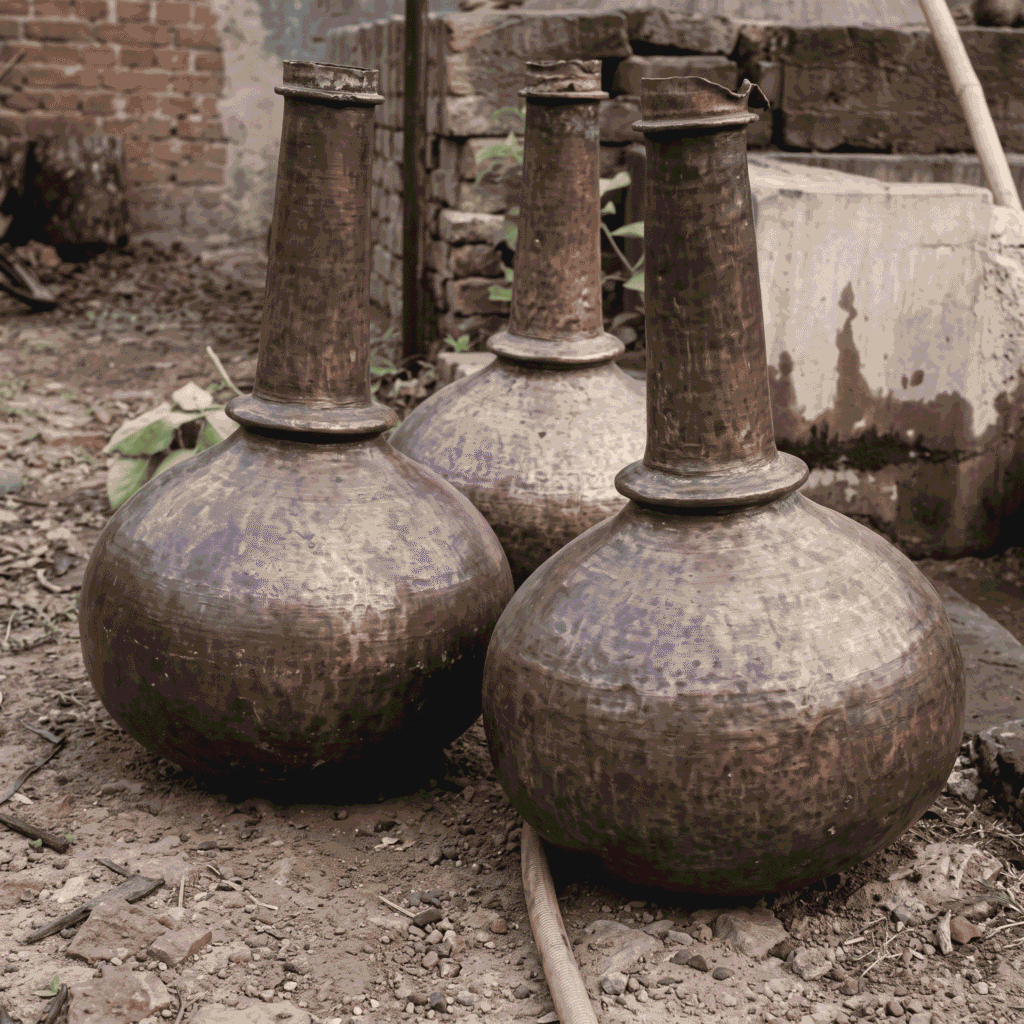
The Bhapka is a copper receiver — round-bellied, narrow-necked — submerged in a water-filled cooling tank called the Gachchi. Inside the bhapka is pure Indian sandalwood oil (Santalum album).
As aromatic steam enters the bhapka through the chonga, the cooling water outside causes it to condense. The aromatic molecules dissolve directly into the sandalwood oil below. The sandalwood does not dilute the scent — it absorbs and holds it, becoming the permanent base.
This cycle repeats: each day, fresh petals are loaded into the deg, the fire is lit, steam is generated, condensation occurs. Day after day, the sandalwood oil in the bhapka becomes more and more saturated with the flower’s aromatic essence.
For Rose Attar, this cycle runs for 15 to 40 days. For Mitti Attar (petrichor — the scent of first rain on dry earth), it can run longer.
Stage 6 — Kuppi Maturation
Once distillation is complete, the attar-saturated sandalwood oil is transferred to Kuppi — traditionally leather bottles made from animal hide, which allow the attar to breathe and mature.
In our family’s workshop, the maturation period lasts several weeks minimum. During this time, the sharp top notes that arise during distillation soften and integrate. The fragrance rounds out. The sandalwood and flower oil cease to be two separate things and become a unified composition. This is why a Mandakani attar opened
on the day of bottling smells different from the same attar six months later. It is not inconsistency — it is the craft completing itself.
The Soul of Kannauj, in a drop.
The Tools of the Trade
Six instruments. Unchanged for a thousand years. Each chosen for a reason.
Deg — The Copper Still
A large domed copper vessel holding 40–160 kg of botanical material and water. Copper is used for its even heat distribution and non-reactive nature with aromatic compounds.
Chonga — The Bamboo Conduit
A hollow bamboo pipe wrapped in rope, connecting the deg to the bhapka. Carries aromatic steam while cooling it gradually en route.
Bhapka — The Receiver
A round copper vessel submerged in cooling water. Contains sandalwood oil that absorbs the condensed aromatic molecules of the flower.
Gachchi — The Cooling Tank
A water trough in which the bhapka is immersed. The cool water causes condensation of aromatic steam inside the receiver.
Kuppi — The Maturation Flask
Traditionally made from vegan/animal hide — allows the finished attar to breathe and mature for weeks, rounding out its character.
Bhatti — The Wood Furnace
A brick chamber beneath the deg. Fuelled with wood or dried cow-dung. No thermostats — heat is monitored by hand and ear by the master distiller.
Why This Method. Why No Other.
The Scent Deepens, Not Fades
Aromatic molecules fixed in sandalwood oil do not evaporate the way alcohol-based sprays do. They warm with body heat and release gradually — evolving through the day. A bottle of spray perfume peaks in the first hour and fades. A deg-bhapka attar deepens from morning to evening.
No Alcohol. No Harshness
Every Mandakani attar is oil-based — carried in Indian sandalwood oil, not ethanol. This makes it suitable for daily wear, prayer, and sensitive skin. It meets the skin gently, without the chemical sharpness of an alcohol-based spray.
It Improves With Age
A well-stored deg-bhapka attar becomes richer over years, not weaker. Some collectors keep attars for decades. The aromatic molecules continue to integrate with the sandalwood base long after bottling. This is the exact opposite of every alcohol-based fragrance, which degrades once opened.
"Our Kannauj Distillery — As It Has Always Been"
No reconstructions. No studio props. These photographs were taken in our family’s distillery in Kannauj.
Experience the Craft in a Drop
Every Mandakani attar you hold is the result of this process — the same copper vessels, the same
wood fire, the same family in Kannauj.
Mandakani Perfumers
117, ASH 1A, Kannauj, Uttar Pradesh — 209725
mandakaniperfumers.in