Don't miss our Festive Offers- up to 40% OFF! Free Testers on All Prepaid Orders.

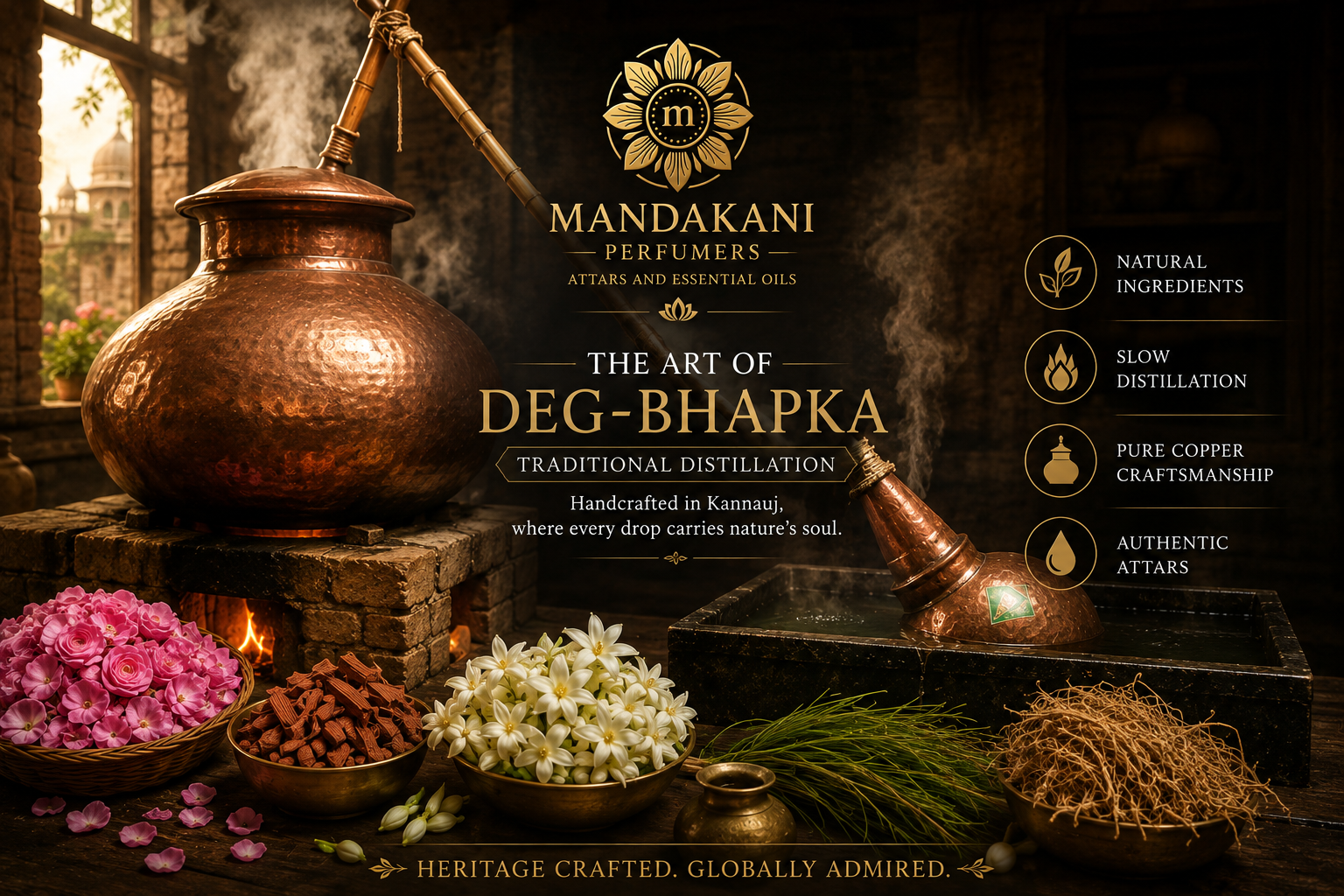
The Art of Deg-Bhapka: Inside Kannauj’s Traditional Attar Distillation

“Some fragrances are manufactured. Others are patiently brought to life.”
A journey inside Kannauj’s centuries-old craft of transforming flowers into timeless attars.
Before the First Drop of Attar Is Born…
Most people see only the finished bottle. A beautifully crafted glass flacon. A golden drop resting gently on the skin. A fragrance that seems effortless. What they rarely see is everything that came before it. Long before an attar reaches your hands, its story begins in silence.
Before sunrise, flowers are gathered while the morning air is still cool. Copper vessels are prepared with the care they have received for generations. Fires are lit slowly—not to hurry the process, but to respect it. Around the workshop, there is no sense of urgency, only quiet confidence built through years of experience.
Walk into a traditional distillation house in Kannauj and you quickly realise that very little happens by accident. Every flower is chosen for a reason. Every vessel has a purpose. Every stage follows a rhythm refined over generations. Nothing feels rushed. Nothing feels mechanical.
In a world where many products are designed for speed, the Deg-Bhapka tradition continues to remind us that some of nature’s finest fragrances cannot be forced. They must be patiently invited.
A Craft That Cannot Be Understood Through Machines Alone
If someone asked you how a violin creates beautiful music, you could describe its strings, its wood, and its shape. But those details alone would never explain the emotion it creates in the hands of a skilled musician. The same is true for traditional attar making. Yes, it involves copper stills, fire, water, flowers, and careful distillation. But those are only the tools.
The true craft lives in the people who understand how each flower behaves, how gently the fire should burn, and how patience often becomes the most important ingredient of all. That is why Deg-Bhapka is more than a traditional distillation technique. It is a living conversation between nature and craftsmanship—one that has quietly continued in Kannauj for generations. And that conversation is where our journey begins.
The Morning Begins Before The Sun-
If you arrive in Kannauj after breakfast, you have already missed one of the most important moments of the day. Long before the city begins to stir, flower growers are already at work. The air is cooler. The petals are fresh. The fragrance is at its purest. This is the brief window that traditional perfumers have respected for generations. Roses are gathered gently, jasmine blossoms are carefully collected, and other delicate botanicals are brought to the workshop as quickly as possible. Not because tradition demands it. Because nature does.
A flower continues to change after it is picked. Every passing hour slightly alters its aroma. Experienced artisans understand this instinctively. The journey from the field to the distillation room is not simply transportation. It is the first step in protecting the fragrance that nature has already created.
A Workshop That Doesn’t Feel Like a Factory-
Walk inside a traditional Deg-Bhapka workshop for the first time, and one thing becomes immediately clear. It doesn’t resemble a modern production facility. There are no automated conveyor belts. No flashing control panels. No constant mechanical noise.
Instead, you notice thick brick furnaces, weathered copper vessels, bamboo pipes, cooling tanks, and the unmistakable scent of fresh botanicals mingling with warm copper and damp earth. The atmosphere is calm. People move with purpose rather than speed. Conversations are short.
Much of the work happens through observation. A quick glance at the fire. A gentle touch on the copper. A quiet adjustment to the cooling water. To an outsider, these actions may seem ordinary. To an experienced distiller, each one is a decision that influences the fragrance waiting to be born.
Meet the Deg — The Heart of the Craft
Every traditional craft has a symbol. For pottery, it is the wheel. For weaving, it is the loom. For Kannauj’s attar makers, it is the Deg. At first glance, it looks like a large hand-crafted copper vessel. Simple. Unassuming. Almost timeless. Yet inside this vessel, thousands of fresh flowers begin one of the most remarkable transformations in natural perfumery.
The flowers are placed inside with clean water. Nothing more. No artificial fragrance boosters. No synthetic aroma compounds. No shortcuts. The vessel is then carefully sealed. Not because it is an old custom. But because every drop of fragrant vapour matters. When the heat begins its quiet work, the aroma locked inside each flower slowly rises with the steam. Nothing is forced. Nothing is rushed. Nature is simply given the conditions it needs to reveal itself.
Fire Is Not the Master—It Is the Partner
Many people imagine that stronger heat produces fragrance faster.
Traditional distillers know better. The purpose of the fire is never to overwhelm the flowers. Its purpose is to encourage them. Too much heat can disturb delicate aromatic compounds. Too little heat can slow the process unnecessarily. Finding the right balance is not a calculation displayed on a digital screen. It is a judgement developed through years of practice.Ask an experienced artisan how they know the fire is correct, and you may not receive a scientific explanation.
Instead, they might smile and say, “You learn to listen.” They listen to the gentle simmer inside the vessel. They watch the movement of the vapour. They observe the rhythm of the distillation. It is knowledge that cannot easily be written into a manual. It is learned by standing beside the Deg, day after day, season after season.
Why Copper Has Never Lost Its Place-
In an age of stainless steel, automation, and precision engineering, people often wonder why traditional attar makers continue to trust copper. The answer is surprisingly simple.
Because it continues to do its job exceptionally well. Copper distributes heat evenly. It has served generations of artisans with remarkable reliability.
More importantly, the entire Deg-Bhapka process has evolved around it. The goal has never been to preserve copper simply because it is old. The goal has always been to preserve the quality of the fragrance. Sometimes, the best technology is not the newest. It is the one that has quietly earned the trust of generations.
“The Deg does not create fragrance. It simply gives nature the space to reveal it.”
When the First Fragrant Vapour Begins to Rise
There is a quiet moment during every distillation that experienced artisans never ignore. It cannot be measured by a stopwatch. It isn’t announced by a machine. It is recognised through experience. As gentle heat works beneath the copper Deg, the flowers slowly begin to surrender what they have protected since blooming in the fields. Not all at once. Not dramatically. Patiently.
The water absorbs their delicate aromatic compounds, and together they transform into fragrant vapour that rises inside the sealed vessel. It is impossible to see the fragrance itself. Yet everyone in the workshop knows it is there. This invisible journey is the beginning of every authentic attar.
The Chonga – A Bridge Between Two Worlds
Once the fragrant vapour leaves the Deg, it enters one of the most distinctive parts of the traditional system—the Chonga. At first glance, it appears to be nothing more than a long connecting pipe. In reality, it serves as a carefully designed bridge between heat and coolness, between extraction and preservation. As the vapour travels through the Chonga, it begins to lose temperature naturally. This gradual transition is important.
The goal is never to shock the fragrance. Instead, every stage encourages a gentle transformation. Traditional perfumery has always understood something that modern manufacturing sometimes forgets: Nature responds best when it is respected, not rushed.
The Bhapka – Where Fragrance Finds Its New Home
If the Deg is the heart of the process, the Bhapka is its memory. This receiving vessel waits patiently at the end of the journey, partially immersed in cool water. As the fragrant vapour enters, it begins to condense once again into liquid form. For classical Indian attars, this is where another remarkable partnership begins.
Instead of being collected on its own, the fragrant essence is traditionally absorbed into a carefully selected natural base—most famously, pure Indian sandalwood oil. Think of sandalwood as an experienced storyteller. It never interrupts the flower. It never competes for attention.
Instead, it listens. It receives. It gently carries the fragrance forward, allowing delicate floral notes to remain balanced and graceful over time. That relationship is one of the defining characteristics of authentic Indian attars. The flower provides its soul. Sandalwood gives it a lasting home.
Cooling Water That Does More Than Cool
Visitors often notice the cooling tank before they understand its purpose. To many people, it simply looks like water surrounding the Bhapka. But that water quietly performs one of the most important roles in the entire system. Without steady cooling, the fragrant vapour would never return to liquid form in the gentle way traditional perfumery requires.
Experienced artisans keep a close watch on the cooling water throughout the process. Too warm. Too cold. Too little circulation. Each small change influences the final result. It is another reminder that Deg-Bhapka is not a machine running independently. It is a living process guided by constant observation.
Every Flower Speaks a Different Language
One of the greatest misconceptions about traditional distillation is that every flower follows the same method. It doesn’t. Rose behaves differently from jasmine. Vetiver responds differently from kewra. Sandalwood is unlike both. Each botanical has its own personality. Its own rhythm. Its own ideal conditions.
Experienced artisans don’t force flowers to behave the same way. They adapt themselves to the flower. This may be the greatest lesson hidden within the Deg-Bhapka tradition. True craftsmanship begins with listening. Not controlling.
The Day Doesn’t End When Distillation Ends
Many people imagine that once the fragrant liquid reaches the Bhapka, the work is complete. In truth, another stage has only just begun. The freshly prepared attar is allowed to settle and mature. Time continues to shape it. The sharper edges soften. The floral notes become more harmonious. The fragrance gradually finds its balance. Like a thoughtfully written piece of music, every note begins to work together rather than standing alone. That quiet transformation cannot be rushed. It is one of the reasons authentic attars continue to fascinate fragrance lovers around the world.
“In traditional perfumery, patience is not the time between two steps. It is one of the ingredients.”
If Modern Machines Are Faster… Why Does This Tradition Still Survive?
It is a question almost every visitor asks. “If today’s technology can produce fragrance much faster, why do artisans in Kannauj still continue with the Deg-Bhapka method?”
The answer has very little to do with nostalgia. And everything to do with philosophy. Modern technology has transformed the fragrance industry in remarkable ways. It has made perfumes more accessible. Production more consistent. Innovation faster. These are genuine achievements.
Traditional attars were never meant to compete with speed. They were created to preserve something different. The character of natural botanicals. The individuality of every harvest. The quiet elegance that only patient craftsmanship can achieve. That is why the Deg-Bhapka method continues to exist. Not because it refuses to change. But because it still creates something people deeply value.
The Difference Between Making a Fragrance… and Raising One
Perhaps the easiest way to understand Deg-Bhapka is to think about gardening. You can buy a fully grown plant from a nursery. Or you can nurture a small sapling yourself. Both become beautiful plants. Yet the experience is completely different. One is purchased. The other is cultivated.
Traditional attars are cultivated. The fragrance is not assembled as quickly as possible. It is allowed to develop naturally, one careful stage at a time. Every hour of distillation contributes something. Every adjustment of the fire matters. Every observation by the artisan influences the final character.
The process feels less like manufacturing… and more like raising something with patience. That difference may be invisible inside the bottle. But many fragrance lovers believe they can sense it when they wear an authentic attar.
A Craft Passed Through Hands, Not Just Books
There are some professions where experience cannot be replaced by instructions. A cookbook can teach someone a recipe. But it cannot instantly create a great chef. The same is true for traditional perfumery. Many aspects of Deg-Bhapka can certainly be documented. The equipment. The sequence. The temperatures. The botanical ingredients.
Yet some of the most valuable knowledge is learned only by standing beside experienced artisans. Watching. Listening. Repeating. Correcting mistakes. Trying again. Generation after generation, this quiet transfer of knowledge has allowed the craft to survive. Not because every artisan works exactly the same way. But because each generation learns the principles before developing its own understanding. That is how living traditions continue.
Why Authentic Attars Never Feel Mass Produced
Pick up two handcrafted clay pots. Neither will be perfectly identical. That is not poor craftsmanship. It is the signature of human hands. Traditional attars carry something similar. Every flower grows under slightly different weather. Every harvest reflects a different season. Every distillation carries small variations that remind us this fragrance began in nature—not inside a laboratory.
Experienced perfumers strive for consistency. But they also respect individuality. The goal is never to erase nature’s personality. The goal is to preserve it as faithfully as possible. This is one of the reasons collectors often speak about attars the same way wine lovers discuss different vintages. Not every year tells the same story. And perhaps that is exactly what makes each one memorable.
Kannauj Is More Than a Place-
When people hear the name Kannauj, they often think of perfume. For those who work here, it means something much deeper. It is the sound of copper lids being carefully sealed. The warmth of brick furnaces glowing before sunrise. The fragrance of flowers arriving from nearby fields. The quiet conversations between artisans who have spent decades perfecting their craft.
Kannauj is not simply where attars are made. It is where generations have learned to understand fragrance with extraordinary patience. That living heritage cannot be packed into a machine. It lives within people. And that may be the city’s greatest treasure.
“A tradition survives not because it is old… but because every generation discovers a new reason to protect it.”
A Tradition That Refuses to Become a Memory
Walk through Kannauj today, and you’ll notice something unusual. The city has changed. Roads are busier. Markets are larger. Technology has found its way into almost every profession. Yet behind many workshop doors, one familiar scene remains unchanged. Copper Degs continue to warm over carefully controlled fires. Fresh flowers still arrive before sunrise. Experienced artisans still pause to observe the fragrance rather than rushing the process. For them, this is not a performance for visitors. It is simply another working day.
Perhaps that is the greatest strength of the Deg-Bhapka tradition. It has never survived because people wanted to preserve history. It has survived because every generation found real value in continuing it. Living traditions do not exist inside museums. They exist because people continue practising them.
The Future of Traditional Perfumery
People often ask whether traditional attar making has a future in a world filled with modern fragrance technology. We believe the answer is yes. Not because tradition is better than innovation. But because they serve different purposes. Modern perfumery continues to introduce exciting ideas, creative compositions, and remarkable technical achievements. Traditional perfumery reminds us of something equally important.
Where fragrance began. How closely it has always been connected to flowers, seasons, patience, and craftsmanship. The future of Indian perfumery does not lie in choosing one over the other. It lies in respecting both. Innovation gives fragrance new possibilities. Tradition gives it roots. The finest fragrance culture is one that honours both.
What We Hope Never Changes
At Mandakani Perfumers, our family’s journey has been connected with Kannauj since 1925. Nearly a century later, our tools may improve. Our quality standards may continue to evolve. Our customers may come from every corner of the world. But there are certain values we hope never change. Respect for nature. Respect for craftsmanship. Respect for authenticity. These are not marketing words. They are quiet promises we make to ourselves before they ever become promises to our customers.
Because heritage is not something a company claims. It is something people recognise through years of consistent work. That is the tradition we hope to continue. Not only for today’s fragrance lovers. But for future generations who may one day wish to discover where authentic Indian attars truly begin.
Before You Experience Your Next Attar…
The next time you open a bottle of traditional attar, pause for a moment before applying it. Imagine the journey hidden inside that single drop. A flower blooming quietly before sunrise. Hands carefully gathering delicate petals. Copper warmed by gentle fire. Invisible fragrance travelling patiently from one vessel to another.
Generations of experience making hundreds of small decisions that never appear on a label. Then place one small drop on your wrist. Not to test it. Simply to experience it. You may never look at natural fragrance in quite the same way again.
A Final Thought
Every culture has traditions that quietly define its identity. For Italy, it may be leather craftsmanship. For Japan, the tea ceremony. For Switzerland, watchmaking. For India, one of those living traditions continues to rise each morning from the copper Degs of Kannauj.
Not loudly. Not dramatically. Simply with patience. The fragrance that finally reaches your skin is only the last chapter of a much longer story. The real story began long before the bottle was filled. And long before the first flower was picked.
“The finest attars are not remembered because they are the loudest. They are remembered because every drop carries the patience of the people who created them.”
About the Author
This article is part of The Fragrance Library by Mandakani Perfumers, a family fragrance house from Kannauj, India, continuing the tradition of natural perfumery since 1925. Our goal is to preserve, document, and share the knowledge of India’s living fragrance heritage through carefully researched articles and authentic craftsmanship.