Don't miss our Festive Offers- up to 40% OFF! Free Testers on All Prepaid Orders.

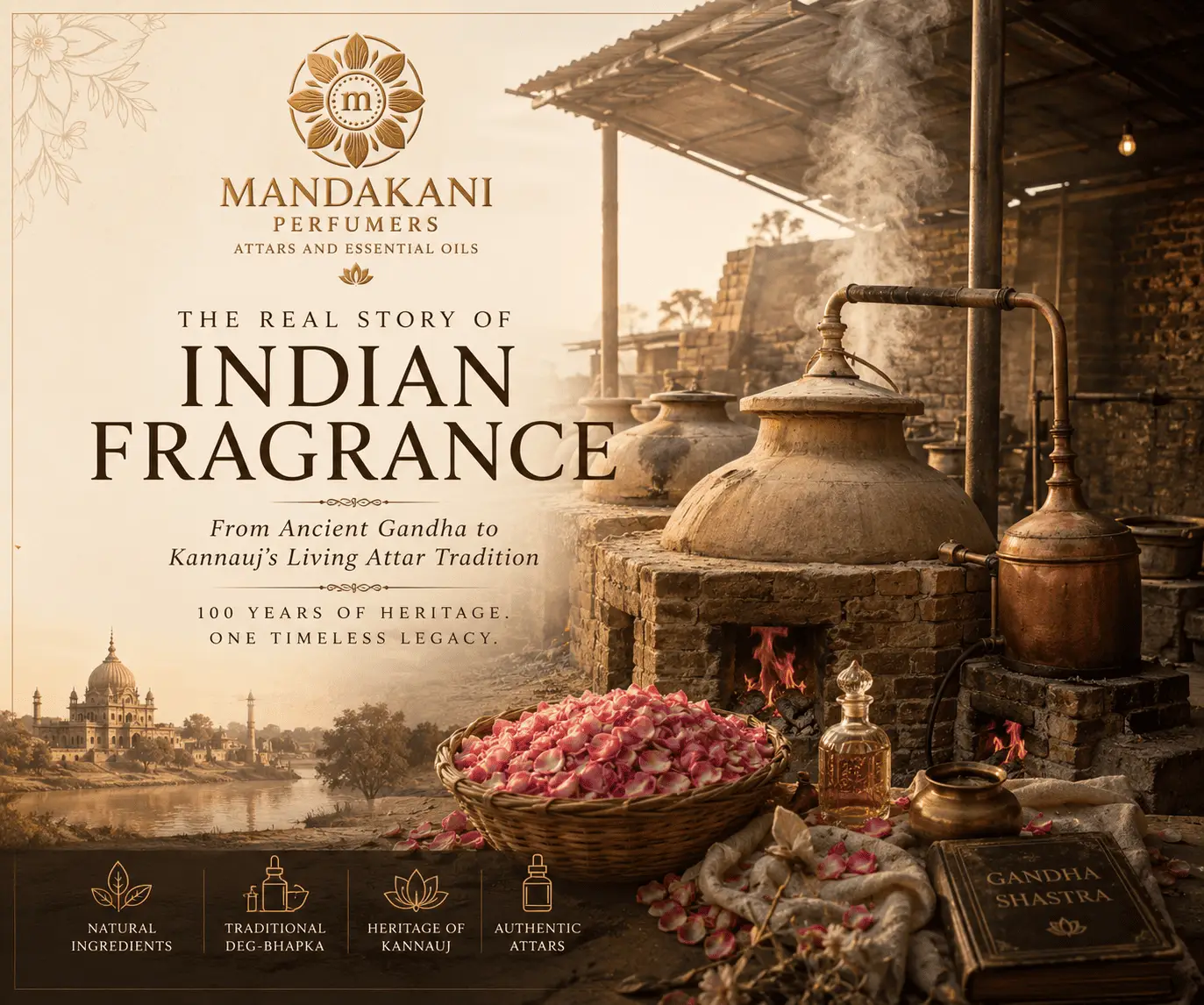
The Real Story of Indian Fragrance: From Vedic Gandha to Kannauj’s Living Attar Tradition

Before Fragrance Became Fashion, It Was a Sacred Tradition and Indian Fragrance History Begins in the Vedic Age
Long before perfume found its place on dressing tables and department store shelves, fragrance held a far deeper meaning in India. It was offered before it was worn. It was experienced before it was admired. It was considered a bridge between the physical world and the spiritual one. Across thousands of years of Indian civilization, and in Indian fragrance history, fragrance was never treated as a luxury reserved for the privileged. It was woven into everyday life—welcoming guests, preparing for prayer, celebrating weddings, healing the body, honouring nature, and expressing respect for the divine. This timeless relationship with scent is beautifully captured in the Sanskrit word Gandha (गन्ध).
Unlike the modern word “perfume,” Gandha carries a richer meaning. It represents natural fragrance, purity, freshness, and the subtle presence of nature itself. In ancient Indian thought, a pleasant fragrance was often seen as a reflection of harmony—between people, the environment, and the sacred. That philosophy continues to inspire artisans in Kannauj even today. At Mandakani Perfumers, we believe every bottle of authentic attar carries more than aroma. It carries memory, patience, craftsmanship, and a living tradition that has travelled across generations. Our family’s journey began in 1925, but the cultural roots of our craft reach much further back—into one of the world’s oldest fragrance traditions. This is that story.
A Journey That Begins Long Before the Word “Perfume”
When people hear the word perfume, many imagine elegant glass bottles, atomizers, and modern fragrance houses. India’s story begins somewhere entirely different. It begins in flowering forests after the monsoon. In fragrant sandalwood groves. In blooming jasmine vines. In sacred temples filled with incense. In rose gardens that greeted the first rays of sunrise.
For thousands of years, the Indian subcontinent has been home to an extraordinary diversity of aromatic plants. Sandalwood, vetiver, jasmine, rose, kewra, lotus, agarwood, henna, and countless medicinal herbs flourished across different regions, shaping a culture where fragrance became an inseparable part of daily life. Ancient communities learned to appreciate these natural aromas not because they wished to manufacture luxury, but because they recognised the emotional and spiritual comfort that fragrance could bring. This close relationship with nature became the foundation of Indian perfumery.
The Meaning of Gandha: More Than Just a Pleasant Smell
The Sanskrit word Gandha appears in ancient Indian literature as a symbol of fragrance, purity, and auspiciousness. In traditional rituals, fragrant flowers, sandalwood paste, aromatic herbs, and natural resins were offered with devotion. Homes were refreshed with botanical aromas. Guests were welcomed with fragrant garlands. Festivals carried the scent of flowers and incense as naturally as they carried music and celebration.
Over centuries, fragrance became part of India’s cultural identity—not because it followed changing trends, but because it reflected a way of living that valued beauty, balance, and respect for nature. This understanding of fragrance still shapes authentic attars today. Unlike many modern fragrances designed to create an immediate impact, traditional attars invite a slower experience. They unfold gradually, evolving with the warmth of the skin and revealing their character over time. That quiet elegance is one reason natural attars continue to be treasured around the world.
The First Keepers of India’s Fragrance Heritage
As India’s appreciation for natural fragrance grew, so did the knowledge required to prepare it. Over time, skilled artisans and merchants became known as Gandhikas—specialists who worked with aromatic flowers, woods, herbs, resins, and botanical ingredients. Their role extended far beyond simply making pleasant scents. They understood seasonal flowers, the quality of raw materials, methods of preserving delicate aromas, and the cultural importance of fragrance in everyday life.
Although today’s tools have evolved, their spirit lives on in the artisans who continue India’s traditional perfume-making practices. Every generation inherits knowledge from the one before it—not only techniques, but also patience, observation, and respect for nature. That philosophy remains at the heart of traditional perfumery in Kannauj.
Why This Story Matters Today
In today’s world, where many fragrances can be blended in hours using synthetic aroma compounds, it is easy to forget that perfumery was once a patient craft guided by seasons rather than schedules. Understanding India’s fragrance heritage changes the way we see a bottle of authentic attar. It is no longer simply a product. It becomes the continuation of a living tradition—one that values natural ingredients, skilled craftsmanship, and the quiet beauty of time itself.
In the next section, we travel to the city that transformed this ancient appreciation for fragrance into one of the world’s most enduring centres of natural perfumery: Kannauj, often called the Perfume Capital of India.
From Sacred Fragrance to a Living Craft: How Kannauj Became India’s Perfume Capital
Every tradition has a place where it finds its true home. For Indian natural perfumery, that place is Kannauj. Situated along the fertile plains of the River Ganga in present-day Uttar Pradesh, Kannauj has been celebrated for centuries as a centre of learning, trade, craftsmanship, and culture. Historians know it as the capital of powerful kingdoms. Traveller’s remembered it for its prosperity. Perfumers came to know it for something even more enduring—its remarkable understanding of fragrance.
But Kannauj did not become India’s perfume capital overnight. Its story was shaped slowly, over generations. The fertile soil surrounding the region nurtured fragrant flowers, aromatic grasses, medicinal herbs, and other botanicals that became essential to traditional Indian perfumery. Farmers, traders, and skilled artisans worked together, creating an ecosystem where knowledge passed naturally from one generation to the next.
Unlike many crafts that gradually disappeared with industrialisation, perfume-making continued to thrive in Kannauj because it remained deeply connected to the rhythms of nature. Flowers were harvested before sunrise, when their aroma was at its finest. Distillation followed the seasons rather than factory schedules. Artisans learned to judge quality by fragrance, touch, temperature, and experience—not by digital instruments alone. That patient relationship with nature still defines authentic Kannauj attars today.
A Tradition Built by Generations, Not by a Single Dynasty
People often ask, “Who invented Kannauj attar ?”The honest answer is that no single king, empire, or individual can claim ownership of this tradition. India’s fragrance culture had already been flourishing for centuries before Kannauj became famous for perfume. Over time, artisans refined their methods, experimented with local flowers, improved their equipment, and shared their knowledge across generations. New ideas arrived through trade and cultural exchange, while older Indian traditions continued to shape the philosophy behind natural fragrance.
This is how living traditions grow. They are not created in a single moment. They evolve—carefully, patiently, and collectively. That is one of the reasons Kannauj remains so remarkable today. It is not a museum preserving the past behind glass. It is a living community where experienced craftsmen continue to practise techniques that have survived because they still work.
Where Nature Became the Master Perfumer
Walk through Kannauj during the flowering season and you quickly understand why this region became synonymous with fragrance. The morning air carries the aroma of fresh roses waiting to be distilled.
Jasmine blossoms are gathered before the day’s heat begins to soften their delicate scent. Vetiver roots, grown in the rich plains, release their cool, earthy character after the first rains. Kewra flowers bloom with a fragrance unlike almost anything else found in nature.
These botanicals are more than ingredients. They are the foundation of an entire craft. Traditional perfumers have always understood that exceptional fragrance begins long before distillation. It starts in healthy soil, favourable weather, careful harvesting, and respect for the natural life cycle of every flower. No machine can replace that understanding.
Why Patience Became the Greatest Ingredient
Modern manufacturing often celebrates speed. Traditional perfumery celebrates patience. A flower cannot be hurried. Its fragrance changes with temperature, humidity, sunlight, and even the hour it is harvested. Experienced artisans know that two harvests from the same field may never smell exactly alike. Rather than forcing nature into uniformity, traditional perfumers learn to work with these subtle differences.
Each batch becomes a quiet collaboration between the grower, the artisan, and the season itself. That is why authentic attars often possess a depth and individuality that cannot be reproduced through mass production. Every bottle tells the story of a particular harvest, a particular season, and a particular moment in time.
Our Family’s Place in This Continuing Story
At Mandakani Perfumers, we do not claim to have created India’s fragrance tradition. We are honoured to be one small part of it. Since 1925, our family has remained connected to Kannauj’s enduring craft of natural perfumery. Across generations, knowledge has travelled not through instruction manuals but through observation, daily practice, and years of working alongside experienced artisans. Learning when a flower is ready for distillation. Recognising the subtle change in aroma as the process unfolds. Understanding that craftsmanship is measured not by how quickly something is made, but by how carefully it is finished.
These lessons cannot be learned overnight. They are inherited through patience, curiosity, and respect for those who came before us. Every bottle we create reflects that philosophy. Not because tradition should never evolve, but because some principles remain timeless. Nature deserves patience. Craft deserves honesty. Fragrance deserves authenticity.
Those values guided our family in 1925, and they continue to guide Mandakani Perfumers today. This legacy drives us today to become the “HOUSE OF MANDAKANI”.
The Next Chapter: The Craft That Captures a Flower’s Soul
Understanding Kannauj explains where India’s living perfume tradition flourished. The next question is even more fascinating: How does a fresh flower, whose fragrance may last only a few hours in nature, become an attar that can be cherished for years?
The answer lies in a remarkable artisanal process that has been carefully preserved in Kannauj for generations—a craft known as Deg-Bhapka distillation. In the next part of this guide, we will step inside the traditional distillation room and explore how copper, fire, water, flowers, and time work together to create one of the world’s most distinctive natural fragrances.
The Art of Deg-Bhapka: Where Flowers Become Timeless Fragrance
If history explains why India’s fragrance tradition matters, the Deg-Bhapka method explains how that tradition continues to live. Walk into a traditional distillation workshop in Kannauj before sunrise, and you won’t hear the hum of automated production lines or see rows of stainless-steel machines working at high speed.
Instead, you’ll find something much quieter. Copper vessels warmed by a carefully controlled fire. Fresh flowers waiting to be distilled. Artisans moving with calm precision, guided by experience rather than haste. The atmosphere feels less like a factory and more like a place where craft is practised with patience. For generations, this has been the rhythm of traditional attar making.
What Does “Deg-Bhapka” Mean?
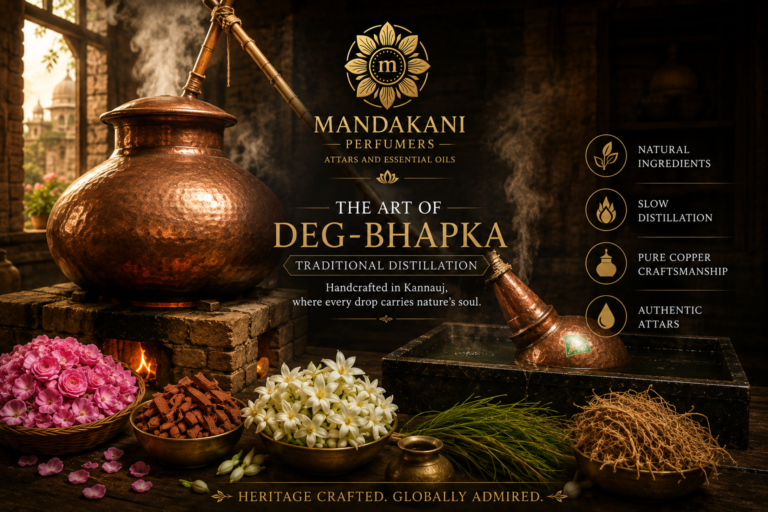
The name comes from two essential parts of the traditional distillation system. The Deg is a large hand-crafted copper vessel where fresh flowers and water are gently heated together. The Bhapka is the receiving vessel, where fragrant vapour cools, condenses, and is carefully collected.Connecting them is a long pipe that allows the aromatic vapour to travel from one vessel to the other. Simple in appearance, this arrangement reflects centuries of practical refinement.
It is proof that remarkable craftsmanship does not always require complicated machinery. Sometimes, it requires understanding nature well enough to work with it instead of against it.
A Flower’s Journey Begins Before Sunrise
Every authentic attar begins long before the fire is lit. It begins in the fields. Many delicate flowers release their finest aroma during the cool hours of the morning. For this reason, harvesting often starts before sunrise, while the petals are still fresh and rich with natural fragrance. Once collected, the flowers are transported as quickly as possible to the distillation workshop.
Time matters. Unlike synthetic aroma compounds, fresh flowers continue to change after they are picked. Delays can reduce the freshness and complexity of their natural scent. That is why traditional perfumers have always valued speed in harvesting—but patience in distillation.
Fire That Never Rushes
The freshly gathered flowers are placed inside the copper Deg with clean water. The vessel is carefully sealed to prevent fragrant vapour from escaping. Then comes one of the most important parts of the entire process.
The fire. Contrary to what many people imagine, the goal is not to boil the flowers as quickly as possible. The heat is introduced gently and monitored continuously. Too much heat can damage delicate aromatic molecules. Too little heat slows the process unnecessarily. Finding the right balance is not something that can be mastered by reading instructions alone. It is a skill developed through years of observation and experience.
Many seasoned artisans can recognise subtle changes simply by listening to the sound of the simmering water, feeling the warmth of the copper, or noticing how the fragrance evolves during distillation. This quiet expertise is one of the reasons traditional attar making continues to command such respect.
Why Copper Has Never Gone Out of Fashion
In an age of modern industrial equipment, people often ask why traditional perfumers still rely on copper. The answer is surprisingly simple. Copper distributes heat evenly. It is durable. It has served generations of artisans with remarkable reliability. Most importantly, it has become an integral part of a process that has been refined over centuries through practical experience. Traditional craftsmen trust copper not because it is old, but because it consistently helps create the gentle conditions needed for delicate botanical distillation. Sometimes the best technology is not the newest. It is the one that has earned its place through generations of successful use.
Capturing What Cannot Be Seen
As the flowers slowly release their natural aroma, fragrant vapour rises inside the sealed vessel. That invisible vapour carries the very essence of the botanical. It travels through the connecting pipe toward the receiving vessel, where cooling transforms it back into liquid. This moment is almost poetic.Only hours earlier, the fragrance existed only within fresh petals blooming in the fields.
Now it has begun a new journey—carefully preserved through water, heat, copper, and time. It is this transformation that has fascinated generations of perfumers. Not because it feels mysterious, but because it reminds us how much beauty nature already holds. The artisan’s role is not to create fragrance. It is to preserve it.
Sandalwood: The Silent Soul of Traditional Attar
One of the defining characteristics of classical Indian attars is the use of natural sandalwood oil as the fragrance’s foundation. Sandalwood contributes far more than its own gentle aroma. It provides depth. Warmth. Balance. It allows delicate floral notes to settle gracefully rather than disappearing quickly.
Instead of overpowering the flower, sandalwood supports it—much like a beautifully crafted frame enhances a painting without distracting from it. This partnership between flower and sandalwood has become one of the signatures of traditional Indian perfumery. It is subtle. Elegant. Timeless.
Why Time Remains the Greatest Ingredient
Modern manufacturing often measures success by speed. Traditional perfumery measures success by patience. An authentic attar is never judged simply by how it smells immediately after distillation. Like many fine natural creations, it benefits from rest. Over time, the fragrance gradually becomes smoother and more harmonious as its aromatic components settle together.
This natural maturation is one of the qualities that collectors and fragrance enthusiasts appreciate most. An attar is not merely bottled. It is allowed to mature into its full character. That is why every bottle represents much more than flowers. It represents days of careful harvesting.Hours of attentive distillation.Generations of accumulated knowledge.And above all, the patience to let nature reveal its finest work in its own time.
More Than a Technique—A Philosophy
For us at Mandakani Perfumers, the Deg-Bhapka method is not simply a traditional manufacturing process. It is a philosophy. A reminder that quality cannot always be accelerated.That craftsmanship still matters. That nature deserves respect.
And that some of the world’s most beautiful fragrances are created not by forcing results, but by allowing time, skill, and patience to work together.This belief has guided our family’s work since 1925, and it continues to shape every bottle that carries the Mandakani name.
Why an Authentic Attar Feels Different on Your Skin
Have you ever noticed that some fragrances announce themselves loudly for a few minutes, only to disappear before the day is over? Natural attars follow a different path. They are not designed to make the strongest first impression. They are designed to create the longest relationship.
That difference begins with the ingredients.While many modern perfumes rely on alcohol to carry fragrance into the air quickly, a traditional attar is built around natural aromatic extracts and a carefully chosen base. Instead of evaporating in a rush, the fragrance unfolds gradually, responding to your body heat, your skin chemistry, and even the weather around you.
This is why two people wearing the same natural attar may experience it slightly differently. The fragrance becomes personal. It evolves. It tells a story that is unique to the person wearing it. Many first-time users expect an attar to behave like a spray perfume. They look for an immediate burst of fragrance. Instead, an authentic attar invites patience. The opening may feel soft. The heart slowly reveals itself.
Hours later, gentle traces of the fragrance continue to remain close to the skin—not demanding attention, but quietly becoming part of your presence. This subtle evolution is one of the reasons natural attars have remained treasured across generations. They do not simply perfume the body. They accompany it.
The Beauty of Nature Is That It Never Repeats Itself
One of the most remarkable qualities of traditional attars is something that surprises many people. No two harvests are ever perfectly identical. A rose blooming after gentle spring rain may carry slightly different aromatic nuances than one harvested during a warmer season. A field that receives abundant sunshine may produce flowers with a richer sweetness, while cooler conditions can reveal fresher, greener facets. To industrial manufacturing, these variations might seem like imperfections.
To traditional perfumers, they are signatures of nature. Every season leaves its own fingerprint.Every flower tells its own story. Rather than forcing every batch to smell mechanically identical, experienced artisans work with these natural differences, respecting the individuality that makes botanical perfumery so fascinating.This is one of the reasons authentic attars often feel alive.They carry the character of real flowers, not laboratory copies.
More Than Fragrance—A Memory in Every Drop
Fragrance has an extraordinary relationship with memory. A familiar aroma can instantly transport us to a childhood home, a family celebration, a quiet temple courtyard, a monsoon afternoon, or a garden filled with flowers. Science tells us that our sense of smell is closely connected to the parts of the brain responsible for memory and emotion. Perhaps that is why certain fragrances remain unforgettable long after the moment has passed. For us, this is what makes traditional attars so meaningful.
They are not created merely to smell pleasant. They become companions to life’s moments. The fragrance you wear on your wedding day. The attar your grandfather applied before leaving for morning prayers. The gentle scent that reminds you of home after years spent abroad. These are not simply perfumes. They become memories preserved in aroma. That, perhaps, is the greatest beauty of natural fragrance. It stays with the heart long after it leaves the skin.
Why House of Mandakani Exists ?
Every bottle of fragrance begins with a choice. Some brands begin by asking, “What is popular in the market?” Others ask, “What can we manufacture faster?” At Mandakani Perfumers, we began with a different question. “What is worth preserving?” For our family, perfume has never been just another product. It has always been a craft that deserves patience, honesty, and respect.
Since 1925, our journey has been closely connected with the living fragrance tradition of Kannauj. Across generations, we have watched flowers arrive before sunrise, seen copper stills warmed by gentle fire, and learned that true quality cannot be measured only by numbers—it is recognised by experience. The world around us has changed dramatically over the last hundred years. Machines have become faster. Production has become larger. Consumer preferences have evolved. Yet one belief has remained constant in our family: Nature should never be rushed. That simple belief continues to guide every decision we make today.
Honouring Tradition While Embracing the Future
Respecting tradition does not mean resisting progress. We believe the future of Indian perfumery lies in bringing together timeless craftsmanship and modern transparency. Today’s customer wants more than a pleasant fragrance. They want to know where the ingredients come from. How they are made? ? Who makes them? Why they smell the way they do? .
We welcome those questions. Because every authentic attar carries a story that deserves to be shared. At Mandakani Perfumers, we believe knowledge should travel with every bottle. When you understand the flower, the season, the craftsmanship, and the heritage behind an attar, you begin to appreciate it in an entirely different way.
Our goal is not simply to create customers. Our goal is to create people who value the remarkable tradition of Indian natural perfumery. If our articles inspire someone to learn about Kannauj, if our fragrances encourage someone to rediscover natural aromas, or if our work helps preserve a craft that has been passed from one generation to the next, then we believe we have succeeded in something much greater than selling perfume.
A Heritage That Continues to Grow
The story of Indian fragrance is still being written. Every season brings new flowers. Every harvest creates new possibilities. Every generation adds its own chapter. We are proud that our family’s chapter began in 1925. But we know the story does not end with us. It belongs to every farmer who patiently nurtures a field of roses.
Every artisan who understands the language of fragrance. Every customer who chooses authenticity over imitation. And every young person who believes that India’s traditional knowledge still has a place in the modern world. That is the future we hope to help shape. Not by looking backwards with nostalgia, but by carrying forward the values that made this tradition meaningful in the first place.
An Invitation to Experience India’s Living Fragrance Heritage
When you hold a bottle of authentic attar in your hands, you are holding more than fragrance. You are holding countless mornings in flower fields. The quiet skill of experienced artisans. The warmth of copper stills. The patience of careful distillation. The wisdom of generations. And above all, a tradition that continues to live because people still believe it is worth preserving. That is the spirit we strive to honour at Mandakani Perfumers.
We invite you not only to discover our fragrances, but also to discover the remarkable heritage that inspires them. Because some stories are best understood not by reading about them… …but by experiencing them, one drop at a time.
The Future of Indian Fragrance Begins with Preserving Its Past
The story of Indian fragrance has never been only about flowers. It has always been about people. The farmers who rise before dawn to harvest blossoms at their most fragrant. The artisans who patiently transform those blossoms into attars using methods refined through generations. The families who quietly preserve knowledge that cannot be measured by machines or captured in instruction manuals. And the people who choose authenticity over convenience, keeping these traditions alive simply by valuing them.
In a rapidly changing world, it is easy to believe that progress always means replacing the old with the new. The history of Kannauj suggests something different. Real progress can also mean protecting what is timeless. Modern technology has made fragrance more accessible than ever before, and that is something to celebrate. Yet there remains a special place for craftsmanship—for products created with care, patience, and respect for natural ingredients. These are not opposing ideas. The future belongs to those who can honour tradition while embracing innovation with integrity. That is the future we believe in.
A Legacy That Lives Through Every Bottle
When our family began its journey in 1925, the world looked very different. India was still decades away from independence. Perfume was crafted by hand, conversations travelled more slowly, and knowledge moved from one generation to the next through observation and practice.
Today, almost a century later, much has changed. People discover fragrances online. Customers compare products from around the world in seconds. Artificial intelligence can answer questions about perfume in moments.But one thing has remained beautifully constant.A flower still blooms in its own season.Its fragrance still cannot be hurried. And authentic craftsmanship still asks for patience.Those simple truths continue to guide our work.Every bottle created by Mandakani Perfumers carries not only the aroma of carefully chosen botanicals, but also the values that have shaped our family for generations—honesty, respect for nature, and pride in the living heritage of Kannauj.
We do not see ourselves as owners of this tradition.We see ourselves as its caretakers.Our responsibility is not only to create authentic attars, essential oils, and hydrosols, but also to help preserve the remarkable knowledge that makes them possible.
An Invitation
Whether you have worn attars for decades or are discovering them for the very first time, we invite you to experience them with curiosity. Notice how they change as the day unfolds. Notice how each botanical expresses its own personality. Notice how natural fragrance speaks quietly rather than loudly. Most importantly, remember that every authentic attar begins long before it reaches the bottle.
It begins in living fields. It continues through skilled hands. It is refined through patience. And finally, it becomes part of your own story. Because every fragrance tells a story. Some fade after a few hours.Others become part of who we are.At Mandakani Perfumers, our greatest hope is that every bottle we create carries forward not only the scent of flowers, but also the enduring spirit of India’s living fragrance heritage.
Thank you for being part of that journey.
About the Author
This article is part of The Fragrance Library by Mandakani Perfumers, a family fragrance house from Kannauj, India, continuing the tradition of natural perfumery since 1925. Our goal is to preserve, document, and share the knowledge of India’s living fragrance heritage through carefully researched articles and authentic craftsmanship.
References
This article has been researched using publicly available historical and institutional sources for educational purposes.
- Intellectual Property India – Geographical Indication (GI) Registry
https://search.ipindia.gov.in/GIRPublicSearch/Application/Details/158
- Fragrance & Flavour Development Centre (FFDC), Kannauj
https://www.ffdcindia.org/ - One District One Product (ODOP) – Kannauj Perfume
By exploring this article randomly on internet helped me in understanding the ancient roots of perfumery world.